 Es PosibleEs Posible
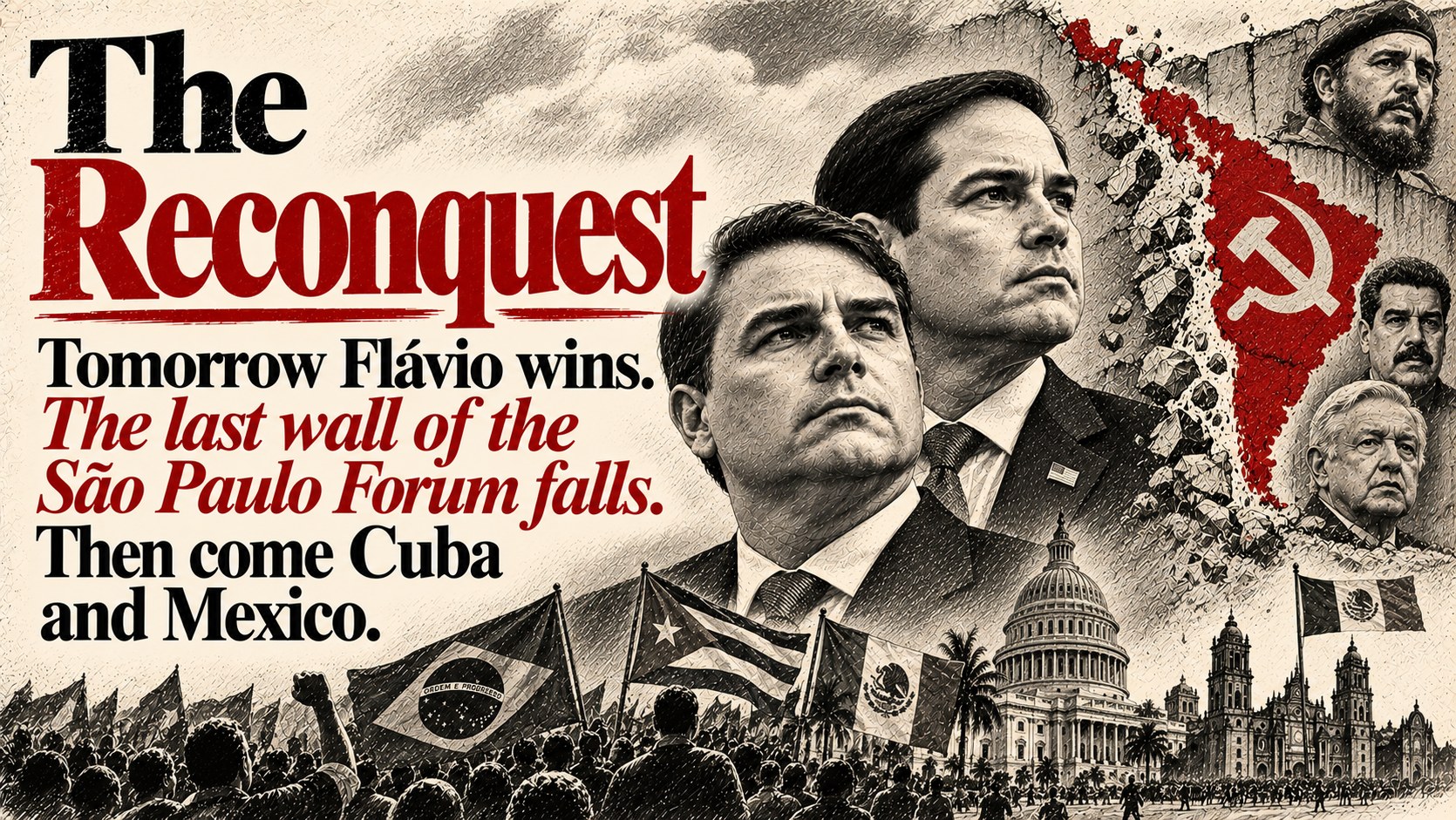
Flávio wins tomorrow. The last wall of the São Paulo Forum falls. Then come Cuba and Mexico.
I wrote it on August 10. The polls missed by five points on October 4. Tomorrow the circle closes.
This map is for anyone who wants to understand what will happen over the next 12 months in Mexico and the Americas.
On August 10 I wrote that Brazil was the next target, and that Brazil was not what was really in play. What was in play was the last foundation stone of the São Paulo Forum.
Fifty-five days later, the polls had Lula ahead and the ballot boxes handed Flávio a lead of two million two hundred thousand votes.
What looked like a surprise that night had been decided earlier, on Sundays, in the tin-roofed churches of the urban outskirts: seven of every ten evangelicals vote for Flávio, and there the church fights the narco, one by one, for the neighborhood boys.
Tomorrow the circle closes. What comes next already has a name: an island without power and a country that votes in June.
I am writing from Brazil, on the eve of the vote. I came to see with my own eyes what the numbers can only count, and the first thing I learned is that here the election doesn't show on the billboards. It shows on the street corners.
In Rio I took Avenida Brasil north. Around Parada de Lucas begins the territory the gang christened the Israel Complex. The Star of David they hung up high is gone: the police took it down in March 2025. The name stayed. And on the walls you still read Bible verses where, in another decade, you read the initials of the Comando.
What changed in the favelas is not the poverty. It is the map of faith. Where there used to be one Catholic chapel per neighborhood, now there is a church on every street: a metal roll-up door, plastic chairs, a keyboard, a long name painted by hand. Assembly of God. God Is Love. Foursquare Gospel. They open when the parish is closed and they stay when the state has already left.
In São Paulo I went at night to an Assembly of God service in the East Zone. Whole families arrived, the men in pressed shirts, the women with Bibles in hand, the children up front. From the pulpit nobody said Lula or Flávio. There was no need. They spoke of family, of the son who left with the gang and came back, of the addiction left behind. At the end, those who wanted to pray for Brazil came forward. Almost the whole church came forward.
I walked out into the street with an idea no poll had given me. In these neighborhoods the church is the only institution that arrives before the narco and stays after the state. Tomorrow that network votes. And it votes together.
Each row is a country where the political map switched sides since Trump returned to the White House, or where Washington has already declared the pressure. The board runs on its own until the polls close in Brazil.
Analysis. "Landed" marks an election or an operation that already happened and left a government aligned with Washington in power. "On hold": declared pressure, no date. "Scheduled": an election with a date.
On August 10, with Brazil tied within a point, I wrote that Brazil was not what was really at stake. What was at stake was the last foundation of the project born in a São Paulo hotel in 1990. And I said the result would hit Mexico before next year's election did.
At that moment the Nexus poll for BTG Pactual had Lula at 46 and Flávio Bolsonaro at 45. The big firms still had Lula ahead. The talk in São Paulo, in Brasília and in the newsrooms of Mexico City was something else: the name was burned, the father was in prison, the son lacked the stature, the Banco Master scandal was going to sink him.
On October 1 I went further and put numbers on it. Flávio wins the runoff with somewhere between 52 and 55 percent. And I warned of what almost nobody wanted to hear: there was a two-point error hiding in the polls, and two points of voting intention are four points of margin.
On Saturday, October 3, Datafolha published its last reading before the first round. Lula 45, Flávio 42, in valid votes. The next day, one hundred twenty-five million Brazilians voted.
Flávio, 47.03. Lula, 45.16. Two million two hundred twenty-four thousand nine hundred sixty-five votes apart, with one hundred percent of polling sections counted by the Superior Electoral Court.
The country's most respected poll missed the margin by almost five points. In the same direction as always.
And it was not just the presidency. Flávio's Liberal Party elected 121 deputies, the largest single-party caucus since the 1988 Constitution. It won 19 of the 54 Senate seats in play, a new record for the party, and it will reach 2027 with 28 senators. Even Randolfe Rodrigues, the Lula government's leader in Congress, lost his seat in Amapá.
What tomorrow decides is not whether the right wins Brazil. In Congress, it already has. What tomorrow decides is who holds the key to the Planalto Palace, and with it the power to use that Congress.
Through September 30, margin over total voting intention; from October 3, over valid votes. The result point is the official TSE count. The projection applies to the latest Datafolha the error it had in the first round: analysis.
Tonight Brazil goes to sleep tied. Tomorrow the polls open at eight and close at five in the afternoon, Brasília time, and before dinner everything is known. Electronic voting doesn't let anyone go to bed in doubt.
The polls from the final week say the same thing in different voices. Datafolha, fielded October 20 to 22, has Flávio at 47 and Lula at 46: in valid votes, fifty-fifty. AtlasIntel for Bloomberg gives Flávio 51.1 against 48.9. Quaest has them dead even. Indexa, 50.6 against 49.4. Alfa, published yesterday, 52 against 48.
But there is a detail in the Datafolha series that nobody is talking about. On October 8 it had Flávio four points ahead in valid votes. On the 15th, two ahead. On the 22nd, zero. Lula closed in two weeks running.
That is the real suspense. Not the tie. The slope.
And here is the question that separates the analyst from the fan: who do I believe, Datafolha's slope or Datafolha's error? It is the same firm that three weeks ago handed Lula a three-point lead that did not exist. If the same bias repeats tomorrow, today's fifty-fifty is a 52.4 for Flávio. Right inside the range I signed.
There is another way to reach the same place, and it is the one I like best because it does not depend on any poll. It is arithmetic. Flávio came out of the first round with 47.03. To win, he needs a little under three points. Ronaldo Caiado, Romeu Zema and Augusto Cury added up to 5.34, and all three declared their support, Cury with the caveat that it was not an unconditional endorsement. Renan Santos, with 2.24, backed no one, but on the night of the 4th he said he saw Flávio's victory as practically settled. Lula has to find almost five points on ground where he has no allies left.
Move the dials yourself. Put each defeated candidate's voters where you think they will go tomorrow. You will see that for Lula to win, you have to assume two hard things at once: that the right that did not vote for Flávio in the first round stays home, and that the polls, for the first time in this election, underestimated Lula and not his rival.
Each row is a candidate who was knocked out. Say how many of every hundred of their voters go to Flávio and how many to Lula; the rest spoil their ballot or stay home.
Other candidates: 0.22, split half and half
of valid votes · Starting point: first round of October 4 · my range 52 a 55
Analytical tool. It does not account for Flávio or Lula voters switching between rounds, or for different turnout by region.
“Two points of voting intention are four points of margin.Simón Levy · forecast of October 1, 2026
To understand why Washington looks at Brazil the way it does, you have to lift your eyes from the electoral map and look at the whole map of the next 12 months that nobody has explained to you, and at how Mexico enters the equation of Marco Rubio's quietest shift.
“The Reconquest doesn't need to invade Mexico. It only needs to leave it standing alone.Simón Levy
Brazil, results: Superior Electoral Court, tally of October 5, 2026 (president, by region and Congress). Caucuses: Congresso em Foco, Poder360 and CNN Brasil, October 5 and 6. Abstention: TSE.
Polls: Datafolha (October 3, 8, 15 and 22; registration BR-09709/2026), AtlasIntel/Bloomberg (October 13 to 18, 4,998 interviews), Quaest (October 17 to 20, 2,154), Indexa/Broadcast (October 20 and 21), Alfa Inteligência (October 23). Datafolha first-round series from August 18 to October 3. Nexus/BTG (July 31 to August 2).
Endorsements: Public statements by Romeu Zema (Oct 5), Ronaldo Caiado (Goiânia), Augusto Cury (Oct 8) and Renan Santos (night of Oct 4).
Forecast: pronostico.simonlevy.mx, October 1, 2026. Original essay: brasil.simonlevy.mx, August 2026.
Region: Electoral tribunals of Bolivia, Chile, Costa Rica and Peru; National Electoral Council of Colombia; Inter-American Dialogue. Shield of the Americas: White House and coverage of March 7, 2026. Rubio tour: September 2026.
Athens: State Department, speech by Marco Rubio at the Pnyx, October 7, 2026 (original English text). Withdrawal from 66 organizations: presidential memorandum and White House fact sheet, January 7, 2026. Designation of the CV and the PCC: State Department, May 28, 2026; in effect since June 5. Remittance tax: Public Law 119-21, since January 1, 2026.
Schools: Flávio Bolsonaro's government plan (Brasil que Prepara pillar); Brazil's Ministry of Education (end of the civic-military program, 2023); El Salvador's Ministry of Education (2024 and 2025).
Faith: IBGE, Censo Demográfico 2022, Religiões, June 6, 2025; censuses 1970 to 2010. José Eustáquio Diniz Alves, 2022 projection. Datafolha and Indexa (evangelical vote). Molina, "Nicaragua: una Iglesia perseguida", 2025 and 2026 installments. Centro Católico Multimedial, report of January 27, 2026. Israel Complex: studies by UFJF and UFMG and 2024 coverage.
China and Iran: Brazil-China trade, January to July 2026, GIS Reports; Stimson Center, October 2026. Itamaraty, statement of February 28, 2026; Embassy of Iran in Brasília, March 2.
Cuba: Pemex, quarterly report to the SEC (first quarter of 2026); Cuba's Ministry of Energy and Mines (May 14, 2026); Marco Rubio's post on X, October 23, 2026; Fort Myers rally, October 23.
Mexico: Department of Justice, Southern District of New York, April 29, 2026; Los Angeles Times, June 3, 2026; The New York Times, June 27, 2026; letter from Andrés Manuel López Obrador, June 3, 2026; INE, 2026-2027 electoral process; Polymarket; USTR, July 1, 2026. Designation of cartels as terrorist organizations: State Department, February 20, 2025. FinCEN, orders of June 25, 2025.
Network: Letter from Democratic senators to Marco Rubio, September 28, 2026. Statements by Eduardo Bolsonaro, September 17, 2026. U.S. Treasury, sanction of July 30, 2025.
Every person mentioned in connection with an investigation or an accusation is presumed innocent. An indictment is not a conviction and a designation is not a verdict. The simulators are analytical tools.